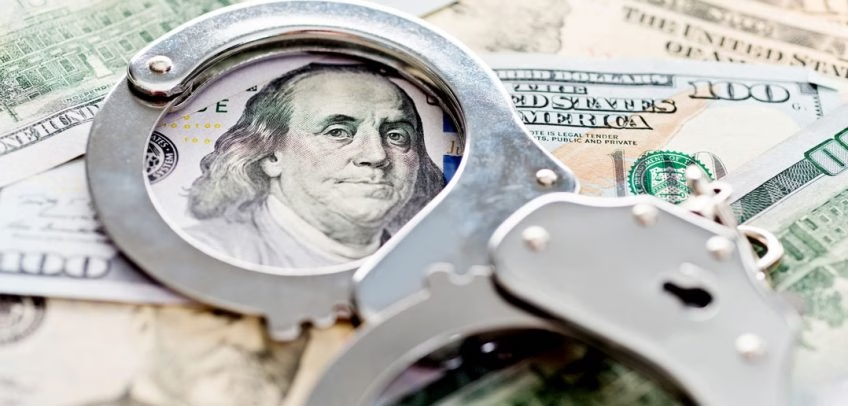

Interested in knowing how to use blockchain to prevent money laundering?
Look no further, as this is what we will discuss here.
How to prevent money laundering with blockchain
There are several use cases for blockchain technology when it comes to AML compliance and the fight against money launderers.
1. Immutable Ledger For Regulatory Oversight
The fact that blockchain technology uses a decentralized network, where each participant or node is required to validate changes, makes it incredibly secure.
Provided a hacker is not able to gain control over 51% of the nodes on the network, something which would require a supercomputer that does not yet exist, any unauthorized change would be automatically resisted by the other nodes.
Since each node has a record of the entire ledger, they are able to compare any change to their record and therefore detect any unauthorized change.
This particular aspect of blockchain technology means that blockchain ledgers can be completely trusted. Regulators would, therefore, be able to examine records knowing that the information contained within them was reliable and accurate.
2. Establish Trustworthy Identifications
Having an immutable ledger that records verified IDs of those behind each and every electronic transaction can act as a massive deterrent to money laundering.
Once again, since such a ledger would be unalterable, it would provide definitive proof in a court of law of a person's or a company's act to launder money.
Any blockchain-based database that involves money or property could be programmed to record verified identification for each party in financial transactions. This would mean these individuals could be held accountable for any financial crime.
Right at this moment, companies like Evernym, a startup that has developed its own blockchain, and Sovrin are racing to develop more secure ways to verify customer identification.
Currently, the market relies on companies such as Equifax, which rely on client-server systems to maintain their databases.
In an article, Vinny Lingham, CEO of Civic, points out the problem of such systems: “These centralized databases are central points of failure for your identity.”
This gives blockchain Customer Due Diligence (CDD) or know-your-customer (KYC) solutions a significant advantage over the systems currently in use.
3. Blockchain for AML Compliance Programs
The question of how to detect money laundering using blockchain technologies is a complex one.
Essentially, any deployment of a Blockchain-based AML solution would require the use/integration of smart contracts.
A blockchain-based AML program that uses smart contracts could leverage built-in algorithms to automate AML compliance and fraud detection, helping combat money laundering.
By programming a set of requirements, such as the need for verified ID, this technology could automatically block or flag suspicious transactions.
In this way, it would be possible to gain oversight of all digital transactions made through participating financial institutions without having to hire large teams of auditors to review them and report suspicious activity.
Governments and law enforcement agencies would be able to implement a financial system that enforces anti-money-laundering regulations, meaning that all financial institutions and cryptocurrencies would have to facilitate such a system to identify money-laundering activities.
Such money laundering schemes would work by allowing each participating financial institution or treasury to act as a node on the blockchain. Whenever a transaction was made, the network would scrutinize it and could flag it as suspicious and require procedures for money-laundering investigations.
It can be argued that an integrated blockchain solution in which all nodes are established financial institutions is not in the spirit of the genuine decentralization concept outlined by Satoshi Nakamoto.
However, the prevention of money laundering, which costs governments tens of billions of dollars in lost taxes, surely has to be more critical.
My Final Thought on Preventing Money Laundering Using Blockchain
All of this is exciting stuff. While the development of a ubiquitous blockchain solution that helps AML compliance officers to prevent widespread money laundering programs is still very far off, this new technology does have enormous potential to succeed where, in the past, we have failed.
Don't forget that it was only after last year's cryptocurrency price spike that a vast number of the new startups that are currently working on this problem were created.
Examining some ICOs gives a good picture of just how much interest and innovation there is in this field.
Small-scale startups tend to focus on solving smaller pieces of the puzzle. The work of companies like Evernym, for example, is already helping to solve the problem of ID verification, which is a major part of money laundering prevention.
When it comes to making a larger dent in the estimated $2 trillion that gets laundered every year, it is going to take the combined effort of governments and the entire finance industry as a whole to really solve this problem.
Given that some of these institutions have been found guilty of money laundering, too, getting them to enthusiastically participate in developing a workable solution might be harder than actually developing the solution itself.
What is clear is that blockchain offers a chance to help put an end to, or at least massively reduce, a criminal activity that has been around for millennia.
Let's hope that blockchain can succeed where all others have failed.
If you are looking to invest in a blockchain solution for your business, DevTeam.Space can help you. Write to us your initial blockchain development requirements via this quick form, and one of our technical managers will get back to you to connect you with our expert blockchain software developers.
Frequently Asked Questions
Blockchain solutions will help to turn the tide in many areas when it comes to the battle against fraud. One area that will really benefit is international money transfers, which will be automated using blockchain, something which will be developed in such a way as to cut down fraud.
Smart contracts will set specific criteria that the sender and receiver must fulfill before it is successful, while a permanent record of all transactions will be stored on the blockchain, helping to cut down on fraud.
There are numerous solutions currently under development. However, no AML solution is in widespread use.