
How I Build and Structure an Agile Scrum Team That Delivers

Nearly 90% of organizations that use Agile methodologies rely on Scrum, according to Digital.ai’s latest State of Agile report.
The appeal is obvious: Scrum is designed to be adaptable, transparent, and collaborative. It promises to replace rigid hierarchies with self-organizing units that deliver high-value software at a faster cadence.
Yet, most "Scrum adoptions" fail to live up to the hype. Companies often go through the motions, like doing daily standups, two-week sprints, and Jira updates, only to continue missing deadlines, shipping unstable code, or burning through their best engineers.
The problem is not really the framework itself. It’s that the Scrum team structure is fundamentally misaligned with the business objectives.
I've seen that high-velocity delivery isn't a byproduct of "doing" Scrum; it's a byproduct of how you distribute authority, skills, and accountability within that unit.
And if you're interested in that, in this guide, I'll move past the textbook definitions to explain exactly what a Scrum team needs to function in a modern business environment.
In this article:
- What "Structuring a Scrum Team" Really Means
- How Scrum Team Structure Directly Impacts Business Outcomes
- 4 Steps to Structuring Your Scrum Team
- When Scrum Team Structuring Won’t Help
- How DevTeam.Space Helps You Structure and Build Scrum Teams
- FAQs About How to Structure Your Agile Scrum Team
What "Structuring a Scrum Team" Really Means
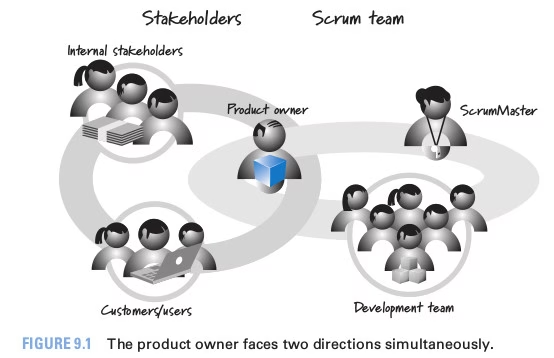
A Scrum Team is a small, cohesive unit focused on achieving a single objective: the Product Goal.
According to the Scrum Guide, a Scrum Team consists of three accountabilities:
- The Product Owner: Accountable for the value of the product.
- The Scrum Master: Accountable for the team's effectiveness.
- The Developers: Accountable for creating a usable increment every Sprint.
There are no additional roles inside the framework. No team leads, no project managers, and no approval layers within the team itself. The goal is to keep the team small, focused, and able to make decisions quickly.

Get a complimentary discovery call and a free ballpark estimate for your project
Trusted by 100x of startups and companies like



It’s also important to understand that "Developers" doesn’t just mean programmers. In Scrum, Developers are anyone who contributes to creating a usable product increment each sprint. That can include QA engineers, designers, DevOps specialists, data engineers, or AI specialists, depending on what the product requires.
So when we talk about structuring a Scrum team, we’re not just talking about assigning titles to Scrum team members. We’re making decisions about how the team actually works in practice.
Key structural decisions include:
Who has decision authority
Does the Product Owner have real ownership of priorities and tradeoffs, or do decisions require multiple approvals? Lack of clear authority is one of the fastest ways to slow delivery.
How skills are distributed across the team
Does the entire Scrum team collectively have everything needed to design, build, test, and release increments? Skill gaps often appear later as delays, bottlenecks, or quality issues.
How stable the team is over time
The Scrum framework relies on learning and continuous improvement. Constantly reshuffling team members resets that learning curve and reduces predictability.
How the team fits into the wider organization
Scrum teams or Agile teams don’t exist in isolation. Reporting lines, shared services, and governance processes can either support or block the team’s ability to deliver.
How Scrum Team Structure Directly Impacts Business Outcomes
The way a Scrum team is structured determines whether the Scrum process delivers value or just exposes problems. Clear roles, the right mix of skills, and stable team membership don’t just make work easier; they directly influence:
Delivery speed and predictability
A team’s structure determines how quickly decisions are made and work moves through the pipeline. When the Product Owner has clear authority, and the Developers have all the necessary skills to design, build, test, and release increments, work flows smoothly.
When the structure is weak, common bottlenecks appear, such as:
- Stakeholder approvals slowing down prioritization
- Dependencies on external teams delaying testing or deployment
- Specialists shared across multiple teams creating unpredictable queues
The result is missed sprint goals, inconsistent delivery, and frustrated teams.
Product quality and technical risk
Quality problems rarely stem from individual effort; they usually come from missing capabilities within the team. For example:
- No embedded QA or test automation means defects are discovered late
- Limited DevOps expertise makes releases riskier and more manual
- Lack of time for refactoring or technical debt leads to accumulating problems
But when these skills are part of the team, quality becomes a built-in process rather than an afterthought. This reduces defects, emergency fixes, and release-related stress.
Team sustainability and burnout
Scrum is designed for a sustainable pace, but poor team structure undermines this. Burnout often results from developers being split across multiple teams and frequent team reshuffling. It also happens when overloaded Product Owners act as intermediaries or Scrum Masters double as delivery managers.
On the other hand, a stable, cross-functional team with clear responsibilities maintains focus and ownership. This protects morale and ensures consistent productivity over time.
Decision-making speed and strategic alignment
Structure also affects how quickly the team can respond to business priorities. Without an empowered Product Owner, teams face conflicting requests, shifting priorities, and backlog indecision.
But with clear authority, tradeoffs happen quickly, priorities align with business goals, and the team can deliver measurable value faster.
4 Steps to Structuring Your Scrum Team
Once the impact of structure is clear, the next step is putting the right foundations in place. These four steps reflect how the Scrum Guide and real-world scrum implementations align when organizations move from theory to delivery.
1. Define clear Scrum accountabilities
The Scrum framework is intentionally simple. A Scrum team has three accountabilities: the Product Owner, the Scrum Master, and the Developers. Together, this unit of professionals focused on one product goal is the fundamental unit of delivery in the Agile framework.
When companies add approval layers or blur responsibilities, the team loses its ability to be self-managing and self-organizing.
Product Owner
The product owner is accountable for maximizing product value and managing the product backlog. This is not a committee role. It must be only one person with the authority to make tradeoffs quickly.
Core responsibilities:
- Ordering and refining the product backlog
- Aligning priorities through strong stakeholder collaboration
- Making scope and priority decisions during sprint planning
- Keeping the scrum team’s focus on value delivery
Scrum Master
The Scrum Master serves the team by helping everyone understand and apply Scrum practices and Agile principles. The Scrum Master ensures the framework is followed and helps remove impediments that slow delivery.
There should be one Scrum Master per team. This is not a project manager role; it exists to enable continuous improvement and strong team performance.
Key responsibilities:
- Facilitate the sprint planning event, daily scrum, sprint review, and sprint retrospective
- Coach teams and stakeholders on adapting Scrum
- Help the organization improve its Scrum implementations
Developers
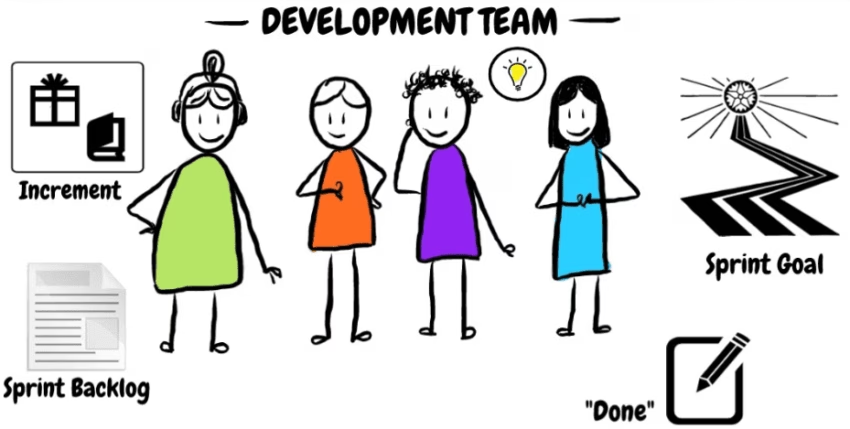
The Developers form the development team, responsible for delivering a usable increment each sprint. The Scrum team is accountable for delivery as a whole, not as individuals.
This group must collectively have all the skills needed for software development, including testing, deployment, and quality.
Common pitfalls to avoid:
1,200 top developers
us since 2016
- Splitting people across multiple team
- Creating sub-teams or hierarchies within the team
- Frequent reshuffling that resets learning
A stable team allows the group to learn from past performance and improve in future sprints.
2. Size your team and balance developer skills
Team size and skill coverage also strongly influence how effectively the team delivers.
Here are some pointers to keep in mind.
Ideal Scrum team size
The ideal Scrum team size is small. The Scrum Guide recommends 10 or fewer people, as, in practice, smaller teams communicate more effectively and move faster.
Smaller teams benefit from faster decisions and fewer handoffs, as well as stronger ownership across Scrum team members. The ability to complete significant work each sprint is also higher.
If workload grows, scale by forming multiple cohesive Scrum teams, not by expanding one large team.
Skill coverage across the whole team
A development team must collectively have all the skills required to deliver a usable increment. When key capabilities sit outside the team, the development process slows due to dependencies and waiting time.
Typical capabilities include:
- Frontend and backend engineering
- QA and test automation
- DevOps and infrastructure
- Data or AI capabilities when needed
- Reassess team composition regularly
Products evolve, and teams must evolve with them. Review whether the team still has the right mix of skills and capacity to support upcoming work.
Track signals such as predictability of delivery, quality trends, the definition of done, and the ability to meet the sprint goal consistently.
3. Structure teams for your business context
It's important to note, though, that there is no universal structure for all Agile teams. The right setup depends on product maturity and organizational complexity, based on where you are in your journey.
Startups and MVP teams
Early teams are typically lean and flexible.
Common characteristics include broad skill overlap, shared ownership, and the willingness to accept controlled technical debt.
For these types of teams, the main risk is over-reliance on a few individuals with specialized knowledge.
Growth-stage companies
As organizations scale, coordination becomes more complex.
Common patterns include:
- Several teams aligned to product areas
- Increased need for stakeholder collaboration
- Early steps toward multiple cohesive Scrum teams
To successfully navigate the shift, watch for shared services becoming bottlenecks or overloaded Product Owners losing focus.
Enterprise environments
Large organizations often combine Scrum with governance and compliance.
Typical characteristics of Scrum teams for this stage are:
- Distributed teams and stronger documentation
- Governance integrated into the definition of done
- Coordination across multiple cohesive scrum teams
The challenge for these teams is ensuring governance supports delivery rather than slowing it.
4. Decide how to source your Scrum team
Finally, remember that how you build the team directly influences stability, ownership, and long-term project success.
When sourcing your Scrum team, keep the following in mind.
In-house hiring
Strong ownership and long-term alignment make internal teams ideal for core products.
Benefits of in-house hiring include:
- Deep domain knowledge
- Strong internal collaboration
- Long-term continuity across Scrum artifacts and releases
The tradeoff, though, is that this method results in slower hiring and higher costs.
Freelancers
Freelancers can provide short-term support and niche, specialized knowledge. They have fast access to skills and can offer flexibility for short-term Agile projects.
However, going this route involves possibly creating weaker long-term ownership and cohesion.
Staff augmentation
You can also opt to augment an existing team, which fills gaps while preserving leadership and culture.

But for this method to pay off, you need to integrate external contributors into the whole team properly and involve them fully in Scrum events and Scrum practices.
Vetted Scrum teams
The best way to source your Scrum members is to onboard fully formed teams experienced in Scrum.
This offers faster ramp-up, proven collaboration patterns, and immediate alignment with the Scrum framework.
Ultimately, though, regardless of the sourcing model, the goal should remain the same: a stable, cross-functional team that can internally decide how to deliver value and continuously improve how the team delivers.
When Scrum Team Structuring Won’t Help
A well-designed Scrum development team can dramatically improve delivery, but only when the surrounding environment supports how Scrum actually works. If the organizational context conflicts with Scrum theory, changing team structure alone won’t improve outcomes.
Here are the scenarios where restructuring won’t meaningfully improve a scrum team’s effectiveness.
1. Fixed-scope, fixed-deadline projects with zero flexibility
Scrum defines work as empirical and adaptive. Teams learn from each sprint and adjust based on feedback and changing priorities.
But when scope, timeline, and budget are locked from day one, there’s no room to apply iterative learning. In these environments, Scrum ceremonies become procedural overhead rather than a tool for better delivery.
2. Highly interrupt-driven operational environments
Scrum assumes teams can focus on planned sprint work. However, if engineers are constantly pulled into urgent production issues, ad-hoc requests, or support queues, sprint commitments become unreliable.
This breaks forecasting and weakens trust in agile practices. In these cases, Kanban or a hybrid model often works better.
3. Organizations unwilling to give teams decision-making authority
Scrum practitioners emphasize self-management and fast decision cycles. If every technical or product decision requires multiple layers of approval, the team cannot adapt quickly enough.
This creates bottlenecks that no team restructuring can fix.
4. Attempting to "scale Scrum" without organizational alignment
Adding multiple Scrum teams doesn’t automatically improve delivery.
Without shared priorities, aligned leadership, and strong cross-team coordination, scaling simply multiplies communication overhead and dependency risks.
5. Treating Scrum as a process instead of a mindset
Many organizations implement the rituals but ignore the mindset behind them. Scrum works best when leadership supports experimentation, trusts teams to make decisions, and accepts that learning and adaptation are part of the development process.
Without that foundation, restructuring alone won’t deliver meaningful change.
How DevTeam.Space Helps You Structure and Build Scrum Teams
Getting a Scrum team right is ultimately about finding the right people and setting up a delivery process that actually works. DevTeam.Space helps you design a team based on your product stage, technical needs, and roadmap, making sure all the skills you need are covered from day one.
We match you with vetted developers who’ve actually done Scrum in the real world, so you can hit the ground running. On top of that, our AI-powered tools help track progress, spot risks early, and keep everyone on the same page during sprint planning, daily scrums, and sprint reviews.
Whether you’re building an MVP, launching an AI product, or scaling an enterprise project, you can hire Scrum developers and get started in days, not months. Teams grow with your product, and you can continuously fine-tune the setup to make sure delivery stays predictable and smooth.
Get in touch and assess your Scrum team readiness today!
FAQs About How to Structure Your Agile Scrum Team
The 3-5-3 rule is a simple way to remember Scrum’s essential components that define how a Scrum team operates: three roles, five events, and three artifacts.
Here's a closer look at this rule:
✓ 3 roles/accountabilities: Product Owner, Scrum Master, Developers
✓ 5 events: Sprint, Sprint Planning, Daily Scrum, Sprint Review, Sprint Retrospective
✓ 3 artifacts: Product Backlog, Sprint Backlog, Increment
The 5 C’s represent Commitment, Courage, Clarity, Collaboration, and Continuous Improvement, which are the core Scrum values that should guide the mindset and behavior of the team.
They influence how team members interact, make decisions, and deliver work consistently.
The 20-30-50 rule provides guidance for managing the granularity of Product Backlog items to balance immediate execution with long-term planning. According to this rule, 20% of items are ideally fully ready for the next sprint, 30% might need refinement before planning, and the remaining 50% is reserved for high-level ideas or future work.
Managing a Scrum team effectively means facilitating the team’s work, maintaining clear priorities, and fostering continuous improvement through Scrum ceremonies and iterative feedback.
Key priorities include ensuring clear roles and responsibilities for all team members, as well as maintaining a prioritized Product Backlog and Sprint Backlog. Organizations should also facilitate Sprint Planning, Daily Scrum meetings, Sprint Review, and Sprint Retrospective, while encouraging the team to learn from past performance and adjust processes.
You can quickly build a Scrum team by defining roles, aligning on goals, assessing readiness, and onboarding cross-functional members to start delivering value immediately.
Here's how you can do that:
✓ Establish Scrum team roles and responsibilities and agreements during a kickstart process
✓ Conduct a technical and process readiness assessment
✓ Onboard Developers, Product Owner, and Scrum Master together
✓ Begin working in weekly sprints for rapid feedback and adjustment
With DevTeam.Space, you can assess Scrum readiness and get matched with the right professionals in 24 to 48 hours. After the foundational setup, we help you stay on top of execution and tracking during weekly sprints to ensure rapid delivery and frequent feedback.
A Scrum team scales effectively by maintaining small, cross-functional teams of 10 or fewer people and coordinating multiple Scrum teams under a shared Product Backlog and Product Owner. It's also important to avoid splitting teams by function (front-end vs. back-end), use a "team of teams" approach to coordinate dependencies and maintain agility, and keep teams aligned on sprint goals and priorities.
Technology enhances Scrum team productivity by automating repetitive tasks, improving collaboration, and providing real-time visibility into progress and issues.
Examples include:
✓ AI-driven testing accelerating error detection
✓ Automated scripts and deployment tools reducing manual work
✓ Integrated communication and project management platforms improving transparency
✓ Dashboards tracking metrics and sprint progress in real time
Scrum team efficiency can be assessed by tracking both quantitative and qualitative metrics to measure delivery, quality, and team satisfaction over time.
✓ Quantitative: throughput, escaped defects, cycle time, velocity trends
✓ Qualitative: team happiness, workload distribution, sprint goal success rate
Use tools to automatically track and interpret metrics, and make sure to focus on trends and patterns, rather than isolated data points.

Alexey Semeney
Founder of DevTeam.Space



Hire Alexey and His Team To Build a Great Product
Alexey is the founder of DevTeam.Space. He is award nominee among TOP 26 mentors of FI's 'Global Startup Mentor Awards'.
Alexey is Expert Startup Review Panel member and advices the oldest angel investment group in Silicon Valley on products investment deals.