Cloud Application Development Services - Outsourcing, Outstaffing, and More
You can use DevTeam.Space Cloud Application Development Services to either outsource your entire project or hire individual developers and manage them yourself.
Cloud Application Development Services Outsourcing
Get a dedicated tech account manager with сloud аpplication expertise managing a dedicated team of сloud аpplication developers following our practice proven agile process.
Cloud Application Development Services Outstaffing
If you are a tech experienced product manager and prefer to manage developers yourself, simply get our best сloud аpplication developers assigned to your project.
Supporting Specialist
We can support you with devops engineers, front-end developers, QA engineers, designers, and other experts needed to bring your project to success.
From Prototype to Enterprise
With DevTeam.Space Cloud Application Development Services, you can build a сloud-powered back-end of any complexity, from prototyping to enterprise solutions.
DevTeam.Space Process
Get a Free Strategy Session
Submit your project and schedule a free strategy session. We'll discuss your project and provide you with an estimate or relevant developers' profiles.
Get a Perfect Match
A team of experts is assigned to your project based on your specific needs. Once approved, we can start within 24 to 72 hours.
Track Progress
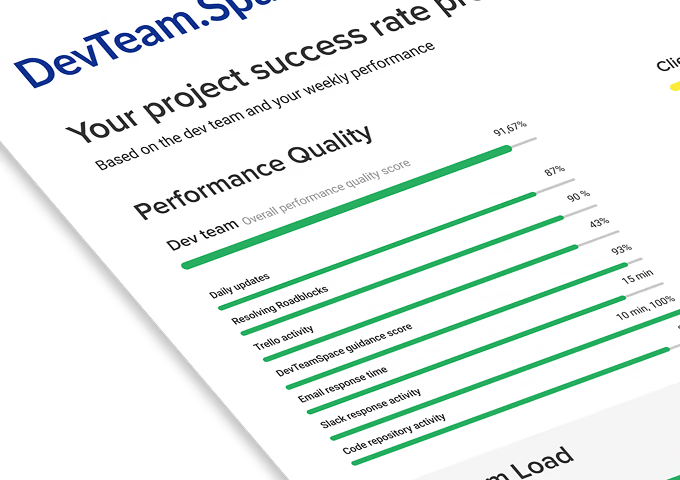
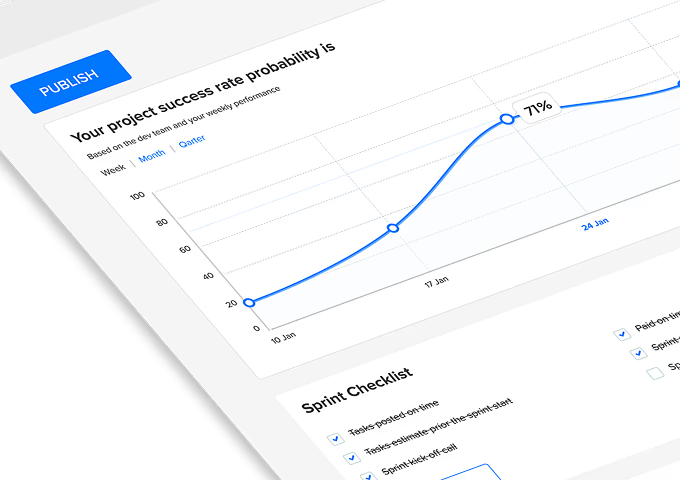
Our proven agile process ensures consistent delivery of your project in weekly sprints, with regular text updates, budget tracking, and Zoom calls.
Refine Your Team and Scale
Expert developers from
the United States, Canada, and Europe
development
teams
Raised by early-stage startups who worked with us.
Recommended by 97% of Our Customers
Right provider for complex projects
DevTeam.Space built a custom web portal for a hedge fund. They handled a complex development project, remaining organized and professional throughout. They’re accessible and tackle any challenge. Customers can expect a quick and skilled development team.
Singapore
Talented, responsive and reasonable!
We manage the IT for an almost 100 year old international Not-For-Profit Foundation. Between our inhouse team and DevTeam.Space we made our deadline, and have received overwhelmingly positive feedback from the end-users and management.
New York, NY
DevTeam.Space rocks
We needed a new long-term product development partner to identify the issues, and ideally, take over the entire product. The performance of our shipping platform increased dramatically since DevTeam.Space stepped in. We plan to continue working with them on a long term basis.
Fort Lauderdale, Florida
Frequently Asked Questions
1. What is cloud application development?
Cloud application development designs, builds, and deploys software that runs on remote servers managed by third-party providers like Amazon Web Services (AWS), Microsoft Azure, or Google Cloud, instead of your local computer or company hardware. This means that you don't need to install anything on-site, and to access the apps, you just need an Internet connection.
These apps also scale with your business needs, so you can add or remove storage and computing power as needed. Updates happen automatically in the background, so you're always on the latest version. And they work across devices and operating systems, so it doesn't matter whether your team is on a Mac, PC, or phone.
2. What can cloud application development services do for my business?
Cloud application development services can help your business cut infrastructure costs, speed up development, scale on demand, and operate more securely.
By moving your applications off local hardware and onto managed cloud platforms like AWS, Microsoft Azure, or Google Cloud, you get:
- Up to 40% savings in IT costs (Accenture report), since you can shift to a pay-as-you-go model where you only pay for what you use, instead of making large upfront investments in servers
- Faster time-to-market and shorter development cycles with automated pipelines and pre-built cloud tools
- The ability to scale up or down so you're never over-provisioning or overpaying
- Global reach, ensuring low-latency performance without requiring physical presence abroad
- Remote collaboration, so teams can work together in real time regardless of location
- Security and compliance via advanced encryption, identity management, etc., so it's easier to protect your data and meet compliance requirements
- Automated backups, which mean your data can be recovered quickly even if local hardware fails due to a cyberattack or natural disaster
- Business intelligence through built-in AI and analytics tools to help you turn raw data into actionable insights that drive better business decisions
3. What makes DevTeam.Space different as a cloud application development company?
DevTeam.Space combines a vetted, invite-only developer community with an AI-powered agile process to deliver structured, managed cloud development, which has won us a 99%+ project success rate for clients across industries over the years.
We set ourselves apart with our:
- Vetted, invite-only community comprised of field-expert development teams, not individual freelancers, all rigorously tested and interviewed before joining
- AI-powered agile process that tracks developer performance, sends daily progress updates, and flags potential roadblocks before they cause delays, so projects stay on track and deliver maximum ROI
- Risk-free trial, so you only pay if you're satisfied with the team's initial work; no financial commitment until you're confident it's the right fit
- Complimentary management and QA for every project, at no extra cost, keeping the team organized and the product bug-free
- Fast onboarding, allowing you to have an entire expert team or individual developers up and running in under 72 hours
And our expertise has been proven at scale. The DevTeam.Space's model is trusted by global brands like Airbus, Disney, Samsung, and NEC. Submit a hiring request to get started!
4. What are the different types of cloud services?
Cloud services differ by how much of the technology stack the provider manages for you, which ranges from raw infrastructure that you configure yourself to fully built software you just log into.
There are three core service models. The first is Infrastructure as a Service (IaaS), which gives you on-demand access to virtual servers, storage, and networking. You're responsible for installing the operating system and apps, as well as managing your data, so essentially, you're just renting the digital foundation. This is best for IT departments and startups that need full control without having to buy physical hardware. Examples include Amazon EC2, Microsoft Azure Virtual Machines, and Google Compute Engine.
There's also Platform as a Service (PaaS), where you can focus entirely on writing and managing your application code. The provider handles the underlying servers and operating systems, providing a complete development and deployment environment perfect for organizations that want to build and launch apps quickly. Examples include Heroku, Google App Engine, and AWS Elastic Beanstalk.
Lastly, there's Software as a Service (SaaS), where you get ready-to-use software over the Internet, with the provider handling all maintenance, updates, and infrastructure. This type is most suitable for businesses that need standard tools like email or CRM without the technical overhead. Examples include Google Workspace, Salesforce, and Slack.
On top of these, there are emerging models like:
- Function as a Service (FaaS)/Serverless, which allows you to run small pieces of code that only execute when triggered by a specific event, and you only pay for the exact milliseconds the code runs
- Containers as a Service (CaaS), which delivers containerized environments (like Docker) instead of full virtual machines, so it's easier to manage apps across environments
- Desktop as a Service (DaaS), where you can stream virtual desktops to users' devices from the cloud, so teams can access a consistent work environment from anywhere
- Anything as a Service (XaaS), which is a broad term covering the growing range of cloud-delivered services, including Database as a Service (DBaaS) and Disaster Recovery as a Service (DRaaS)
5. What is the difference between web app development and cloud app development?
The biggest difference between web app development and cloud app development is how the apps are accessed. Web apps run exclusively in a browser, while cloud apps can be accessed from a browser, mobile device, desktop, or even IoT and edge devices, and are built to handle far greater scale, reliability, and flexibility.
6. How much do cloud application development services cost?
Cloud development services typically cost between $10K to $400K+, depending on the project's complexity and the location of the developers, with ongoing operational and maintenance costs. Basic apps or MVPs normally start from $10K, while medium complexity apps cost anywhere from around $70K to around $120K. Enterprise apps, meanwhile, can go up to $400K or more.
Recurring monthly expenses also have to be factored in, such as cloud infrastructure ($1K-$5K per month), maintenance and updates (15 to 20% of the development costs annually), and third-party services (for payment gateways, advanced analytics, etc.).
7. Can you migrate my existing applications to the cloud?
Of course, we specialize in migrating existing applications and databases to the cloud. We can also transform legacy systems into cloud-native solutions with minimal downtime and business disruption.
8. How long does it take to develop cloud applications?
Cloud application development typically takes 3 to 12 months from concept to launch. A basic MVP can be ready in 10 to 16 weeks, while large-scale enterprise systems with complex integrations can exceed 18 months.
9. Does DevTeam.Space offer cloud application development services with legal IP protection?
Absolutely! We provide comprehensive legal intellectual property (IP) protection through a "work-for-hire" master agreement, mutual NDAs, and restricted access. If you have no prior experience with IP protection, we can provide guidance on best practices throughout the development lifecycle. And once the project is complete, we transfer all documentation and information to you, upon request.
Featured Articles for Cloud Application Development Services
Explore our in-depth product development tutorials and new technology announcements created by our software development experts. Our content created by humans for humans.