Top 10 VR Software Development Tools 2026

Want to know about the top 10 tools for VR development in 2026? Or are you interested in how big the VR market is in 2026 and what the future developments of VR are?
There are loads of great tools out there to help you with the development of your virtual reality (VR) software. This article will answer all the most popular and exciting questions about the top VR tools for software development in 2026.
Let's get started!
In this article
According to a recent GlobeNewswire study, the virtual reality market is expected to reach $56.25 billion by 2025.
Given just how much companies stand to gain by getting into the virtual reality market, there really is no time like the present to start developing a VR software solution.
Top 10 VR Software Development Tools
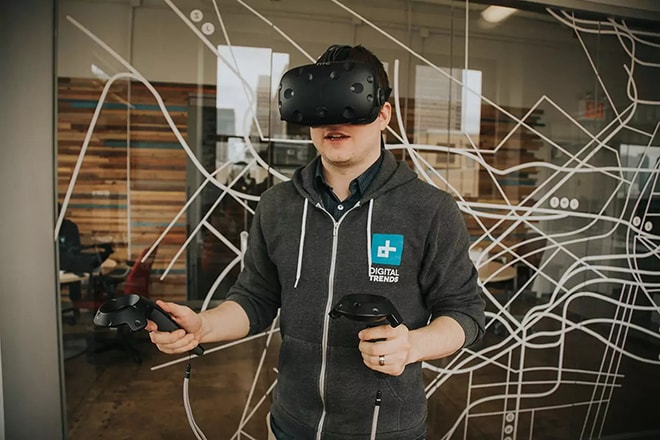
Virtual reality software can offer plenty of value to your business; however, virtual reality app development can be tricky. Robust virtual reality tools assume importance here; therefore, here are my top 10 virtual reality tools to help you.
1. Unity real-time development platform/ VR development
Unity is famous for game development. However, it helps you to build VR solutions for many other sectors, too. For example, you can create VR solutions for automotive, transportation, manufacturing, media & entertainment, engineering, construction, etc., with Unity.

Get a complimentary discovery call and a free ballpark estimate for your project
Trusted by 100x of startups and companies like



You can get a valuable set of tools when you use Unity, e.g.:
- A powerful editor to create Unity 3D VR assets;
- Artist and designer tools;
- CAD tools;
- Collaboration tools.
Read more about them in “Unity: performance by default, high-fidelity real-time graphics, and artist tools.” Unity works with all popular VR platforms like Oculus, Sony, etc.
Unity offers a portal to learn its products, where a VR developer can access courses like “Getting started with Unity”, and many more. The Unity support & services portal will enable you to access its detailed documentation and get the help you need.
Your team can read the detailed Unity user manual to get started. Moreover, you can refer to the Unity FAQ page if you have questions. Check out the pricing plans for Unity.
2. Babylon.js 3D engine/ VR development
Babylon.js is an open-source rendering engine for displaying 3D graphics in web browsers.
Games are one of its main use cases. It can be used to create games that can run on any web browser.
With Babylon.js, it’s possible to create metaverse apps on the web. You can use it to create immersive spaces for meetings, classes, and other events.
It’s also good for building cross-browser VR web experiences thanks to the support for WebXR (an API for accessing VR devices).
Developers can use it as a 3D engine for creating digital twins, highly detailed 3D models of real-life objects. It can also be in IoT for data visualization.
Babylon.js has powerful features. Some of them are:
- Physically-based rendering;
- User input and interaction;
- Physics;
- Animation;
- Particle systems;
- Custom node materials.
Read more about these features in Introduction to Babylon.js Features.
You can access extensive learning resources that will help you use Babylon.js. Their documentation portal has plenty of valuable information that’s useful for any virtual reality developer.
You can access their repository on GitHub. Developers who use AWS tools can access the AWS suite of tools for interacting with the Babylon.js Editor.
3. A-Frame web framework/ VR tool
A-Frame is an open-source web framework for building VR experiences. It's written in JavaScript and is based on top of HTML. That makes it beginner-friendly.
A-Frame supports most VR headsets, including Vive, Rift, Windows Mixed Reality, Cardboard, and Oculus Go. A-Frame utilizes the WebXR API to access VR headset sensor data.
A-Frame offers a wide range of features, and you can use them to create an immersive VR experience for your stakeholders. For example, developers can create VR just using tags without installing anything. You can read more about these features.
To get a better idea of how this framework works, visit their Introduction page. It offers extensive documentation and guides. The platform has a large community that can help should you have any questions or issues with building your VR software.
You can access their repository on GitHub. Their FAQ page contains a lot of useful information.
1,200 top developers
us since 2016
4. Unreal Engine 4 (UE4)/ 3D content creation tool
Unreal Engine 4 (UE4) offers a powerful set of VR development tools. With UE4, you can build VR apps that will work on a variety of VR platforms, e.g., Oculus, Sony, Samsung Gear VR, Android, iOS, Google VR, etc.
The UE4 platform has many features, e.g.:
- It offers access to its C++ source code and Python scripts; therefore, any VR developer in your team can study the engine in detail and learn how to use it.
- UE4 has a multiplayer framework, real-time rendering of visuals, and a flexible editor.
- With the Blueprint visual scripting tool offered by UE4, you can create prototypes quickly.
- It’s easy to add animation, sequence, audio, simulation, effects, etc.
You can read more on the UE4 features page. UE4 is extensible, and it has a rich ecosystem.
UE4 has extensive documentation, and you can access it on the Unreal Engine 4 documentation page. You can also learn UE4 on Unreal Online Learning.
5. CryEngine/ game engine
Well-known to 3D game developers, CryEngine is a robust choice for a VR software development tool. This exciting VR technology allows you to build virtual reality apps that will work with popular VR platforms like Oculus Rift, PlayStation 4, Xbox One, etc. vr technology.
CryEngine offers various features, e.g.:
- You can incorporate excellent visuals in your app.
- Creating a VR app or VR game is easy with CryEngine since it offers a sandbox and other relevant tools.
- You can easily create characters.
- There are built-in audio solutions.
- You can build real-time visualization and interaction with CryEngine, which provides an immersive experience for your stakeholders.
Read the “Features” page on the CryEngine website to learn more.
CryEngine offers excellent documentation; moreover, you can get its entire source code. Read the CryEngine V manual for more information. There are also useful tutorials for CryEngine, and you can access them on the tutorials page on its website.
6. Blender 3D creation suite/ VR set of tools
Blender is an open-source 3D creation suite, and it’s free. At the time of writing, Blender 2.80 is its latest release. The Blender Foundation, an independent organization for public benefit, governs the development of Blender.
Blender offers the following features and capabilities:
- You can create your 3D pipeline with modeling, rigging, animation, simulation, rendering, and motion tracking.
- Blender supports video editing and the creation of VR video games.
- If you have an experienced VR developer on your team, then they can use its API for Python scripting to customize the application. This allows you to create specialized tools.
Read “Free software never looked this awesome” to learn more about the features of Blender.
You can download Blender for use on a Windows, Mac, or Linux computer. Visit the documentation page on the Blender webs iteto read its manuals. Moreover, you can access its tutorials.
7. 3ds Max 3D computer graphic program
3ds Max is a popular 3D modeling and rendering software from Autodesk, and you can use it for design visualization, the creation of video games, etc. This powerful software offers a wide range of features, for example:
There are learning resources and tutorials that will help you to learn SketchUp Studio, and you can access them on the SketchUp Help page of its website. You can find its pricing plans on the plans and pricing page on its website.
- You can create professional-quality 3D animations with its virtual environment kit.
- 3ds Max offers an efficient and flexible toolset to produce high-quality 3D models.
- There are various options to create textures and effects, and you can read about them on the features page on the 3ds Max website.
- You get an impressive array of 3D rendering, UI, workflow, pipeline, 3D animation, and other capabilities with 3ds Max.
Besides all this, 3ds Max offers excellent documentation and tutorials. To access them, you need to visit the support & learning page on its website. You can access video tutorials, troubleshooting guides, and many more helpful resources to effectively use 3ds Max.
8. SketchUp Studio 3D modeling program
SketchUp Studio is a powerful 3D modeling tool focused on the construction industry and architecture, and you can use it for virtual reality app development. It’s useful for use cases like architecture, commercial interior design, landscape architecture, residential construction, 3D printing, and urban planning.
Its powerful desktop tool comes with an easy-to-use UI, meaning that designing your building in 3D will be easier. This tool allows you to create compelling graphics. Moreover, SketchUp Studio offers construction industry-specific features. You can build both VR and Augmented Reality (AR) apps using this tool.
9. Maya VR toolset/ VR software
Maya is a VR software development tool from Autodesk. With Maya, you can create 3D animations, motion graphics, and VFX software.

Maya is a powerful software that offers tools for dynamic effects, 3D animation, 3D rendering, 3D shading, 3D modeling, pipeline integration, motion graphics, etc. It really does make VR implementation easy. Read more about it on the platform's features page on its website.
The support & learning page on its website offers excellent resources for learning this product suite. You can also download software and access troubleshooting guides on this webpage.
10. Cognitive3D VR, AR, MR platform/ VR tools
Cognitive3D is a Canadian-based project. It’s a spatial analytics platform that measures human behavior in VR environments and provides insights based on the results of the analysis.
3D analytics helps you capture the nuances of the 3D experience and improve your apps. For example, for the gaming and entertainment industry, you can gather data that will help you understand player stories and improve your gaming and entertainment apps.
You can read more about use cases on the platform’s website.
Cognitive 3D supports the Unity and Unreal engines. You can connect the Cognitive 3D SDK with Unity or Unreal applications. It’s compatible with all VR/AR, PC, mobile, and tablet devices. You can access their SDK and API on their documentation portal. The platform offers a three-tier pricing plan.
Planning to Engage in VR Development for Your Business?
The 10 virtual reality software development tools I have described above can help; however, developing a VR solution that gives first-rate VR experiences can be complex. You need to hire highly competent VR developers.
I recommend that you engage a reputable software development company for such projects. It can be hard to find such a development partner. DevTeam.Space is a community of expert VR and software developers. We have extensive knowledge in the VR and AR industry, having built many virtual reality software solutions.
Let us know your project specifications via our DevTeam.Space specification form, and one of our managers will get back to you to answer any questions you might have, or discuss further how we can help.
DevTeam.Space is an innovative American software development company with an over 99% project success rate. DevTeam.Space builds reliable and scalable custom software applications, mobile apps, websites, live-streaming software applications, speech recognition systems, ChatGPT and AI-powered solutions, and IoT solutions, and conducts complex software integrations for various industries, including finance, hospitality, healthcare, music, entertainment, gaming, e-commerce, banking, construction, and education software solutions on time and budget.
DevTeam.Space supports its clients with business analysts and dedicated tech account managers who monitor tech innovations and new developments and help our clients design, architect, and develop applications that will be relevant and easily upgradeable in the years to come.
Frequently Asked Questions on VR Development
VR development is a niche industry. While most developers can handle certain elements of creating the underlying software for VR applications, VR also requires skills in mixed reality 3D imaging technology and many other areas. Hire experienced VR developers only.
It is possible to find freelance VR developers online. However, the quality of these developers varies considerably. You should hire full-time VR developers from platforms such as DevTeam.Space. These programmers are vetted for quality, and their work is covered by contracts.
There is a wide range of tools available to help with VR development. Many are cloud-based tools and are available on subscription. We recommend that you read this article to learn about 10 great tools for VR development.
Related Virtual Reality Software Development Articles
Learn more about developing virtual reality software from our expert articles:

Alexey Semeney
Founder of DevTeam.Space



Hire Alexey and His Team To Build a Great Product
Alexey is the founder of DevTeam.Space. He is award nominee among TOP 26 mentors of FI's 'Global Startup Mentor Awards'.
Alexey is Expert Startup Review Panel member and advices the oldest angel investment group in Silicon Valley on products investment deals.